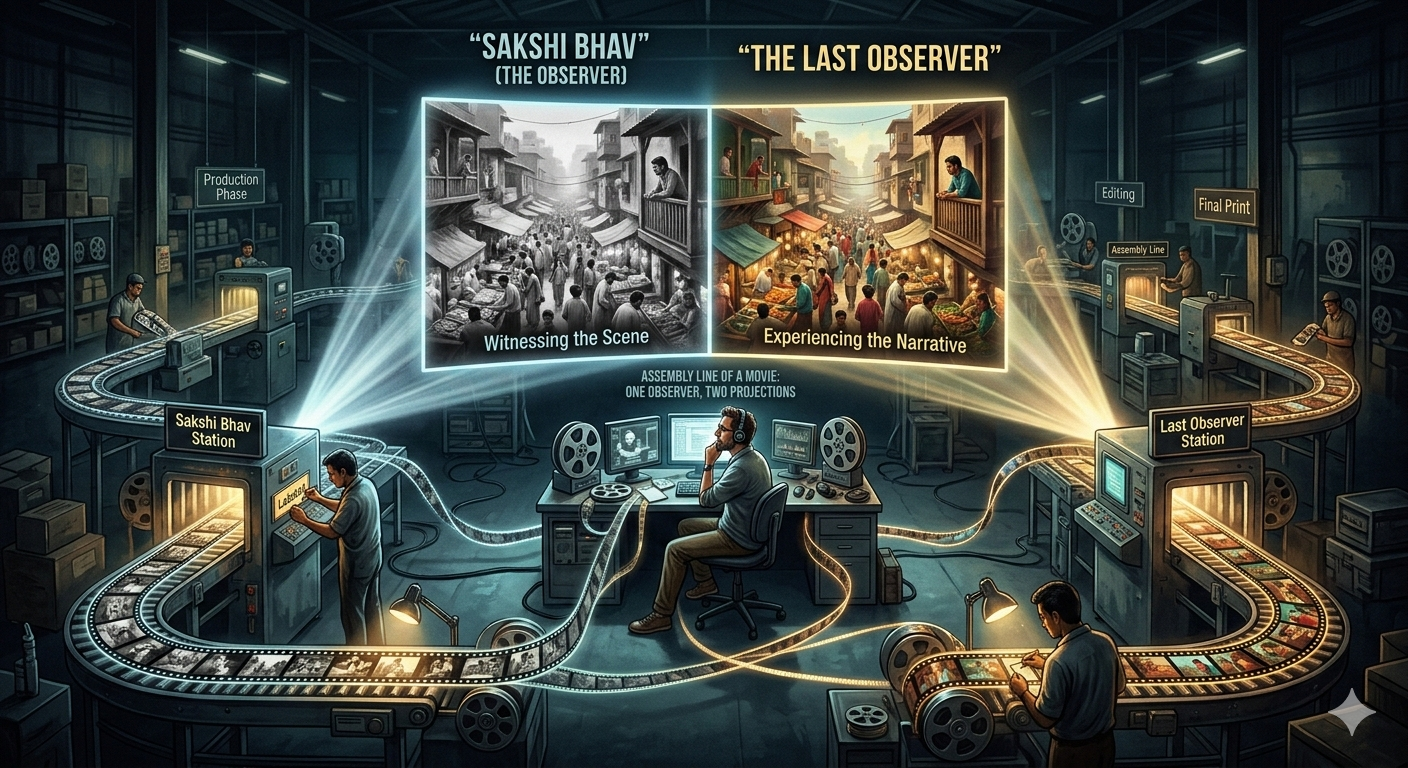
Sakshi Bhav was an extremely important teaching and realization. It served as essential preparation until one enters TGA or reaches a certain level of consciousness where understanding deepens toward the simulation concept — its coded structure, its fake copies, and the idea of being not just a character but a game player, a programmer, and ultimately someone who reclaims their power as an architect — someone capable of changing the rules of this matrix, game, or simulation.
This is advanced teaching. It requires a foundation — the realization that “I am the observer.” Different spiritual practices, gurus, sects, and paths ultimately lead to this single point: you are the observer of your reality.
When this realization happens, you may experience timelessness. You may feel divine love. You may sense ultimate truth. You may encounter your own Self and believe you are enlightened.
But this is where the teaching, until now, was designed to stop.
The benchmark set by gurus, sects, and spiritual systems ends at this observer realization. Many who walked different paths felt they had transcended maya, the matrix, and the cycle of birth and death.
However, when we explore deeper perspectives — through Dr. Neruda’s interviews, near-death experiences, and the teachings of Izumiji and Praveen — another possibility emerges: that even so-called enlightened masters may not be fully free and could still be within the system.
The Matrix Architect is portrayed as highly intelligent and capable of generating convincing layers of reality — simulations within simulations — where one may believe they are free while still operating within a designed framework.
When we observe the current state of consciousness in humanity — confusion, manipulation, distorted religion, misuse of power — it raises the question: Is this truly ultimate freedom?
From this perspective, enlightenment may not be the final goal. The deeper aim becomes transcending the entire framework of limitation itself — breaking distorted patterns, old rules, manipulated timelines, and unconscious cycles.
This is where the shift from observer to last observer takes place.
A last observer does not stop at noticing that reality appears to shift under observation. Instead, the realization deepens:
If reality is not fixed and changes in response to observation, then observation itself holds transformative power.
The “quantum jump” is no longer accidental. It becomes intentional. It is not just about jumping — it is about choosing where to land and understanding the mechanism of the jump itself.
When you internalize both realizations — that you are the observer, and that you are the last observer — something shifts profoundly. Past and future are seen as experiences arising in the present moment of awareness.
As identification with old conditioning, belief systems, and inherited narratives dissolves, trust in one’s deeper consciousness strengthens.
From this state, transformation feels possible.
When you change, your experience of reality changes.
Observer is one.
Observer is observing.
Observer realizes.
Observer becomes the last observer.