We have experienced this world through love, compassion, humanity, cruelty, selfishness, and most importantly, through the growing desensitization of our emotions.
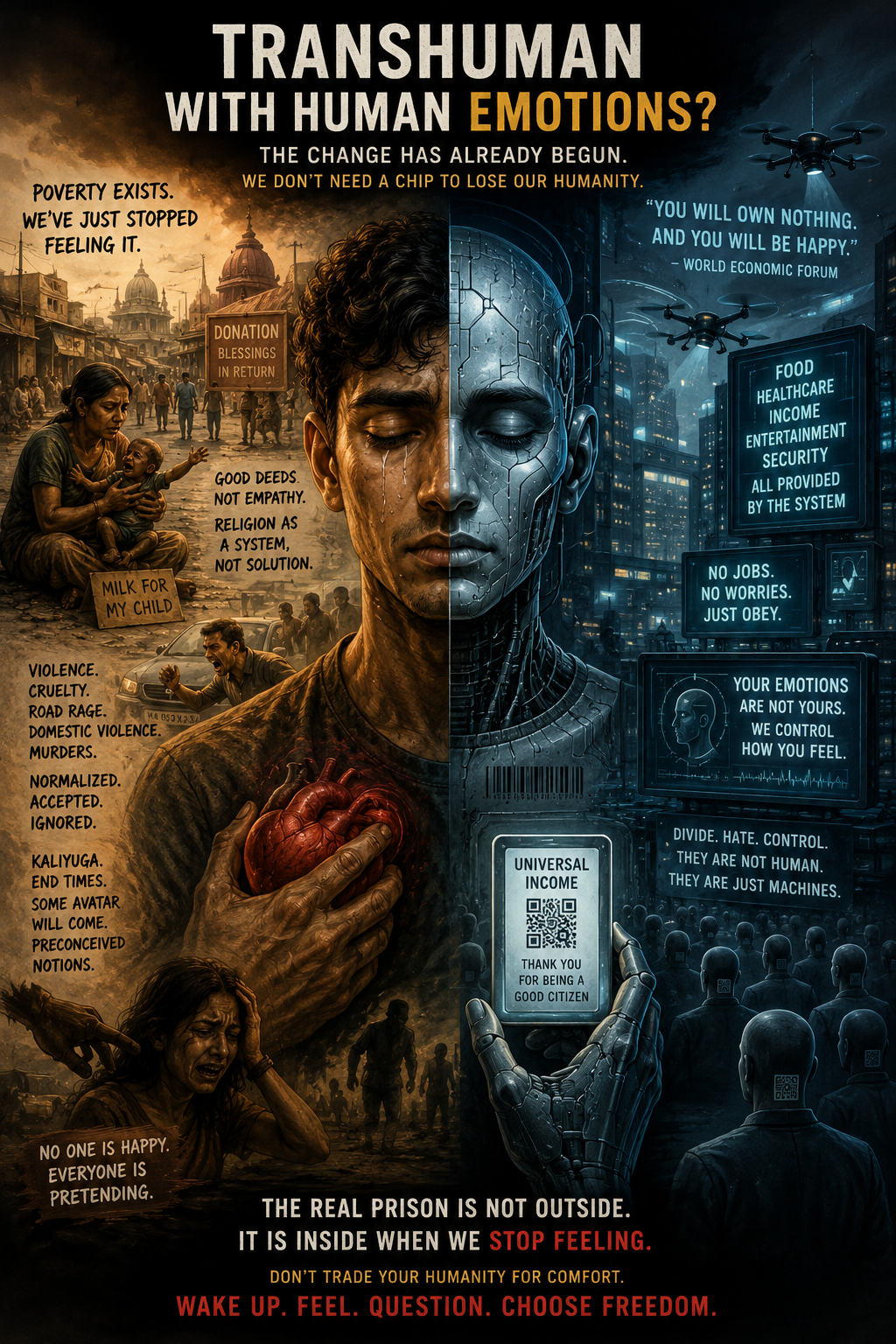
Poverty exists in both developing and developed countries, yet many people have become numb to it. In India, poor people are often seen as suffering because of their past karma, and many people help them not out of empathy or human connection, but because they hope to earn good karma in return.
In countries where religious teachings play an important role, people are encouraged to follow certain moral codes so that one day they will stand on the right side of judgment and be closer to God. But if you observe people carefully, many abandon those same principles when it benefits them.
People who donate large amounts of money to churches, temples, and mosques often have their own agendas. Instead of looking for real and lasting solutions, they frequently support the very systems that keep problems alive.
You see wealthy gurdwaras and countless community kitchens feeding people every day, yet many of those who depend on these systems become more dependent instead of using the support as a stepping stone to improve their lives.
World leaders are trying to influence our food, our lifestyles, and our jobs. Systems are being created that can make people increasingly dependent on them. One idea often associated with future economic models is, “You will own nothing and be happy” When combined with concepts such as universal income, it raises an important question: Does this create another form of dependency, similar to what we see among the most vulnerable people in society?
When you constantly see poor and helpless people—a mother begging for milk for her child, heartbreaking stories on social media, or suffering shown in the news—you slowly become desensitized to it.
But perhaps we do not need a chip inside our bodies to become transhuman.
Maybe the process has already begun.
Look around.
Road rage is increasing. Violence against women and children is increasing. Murders, domestic violence, abuse, and cruelty are becoming common. The most frightening part is not that these things are happening.
The most frightening part is that they are starting to feel normal.
People watch these stories and continue with their day.
People watch videos of violence while eating dinner.
People hear about suffering and immediately move on to the next form of entertainment.
The emotional response that once made us human is slowly disappearing.
And society is beginning to accept it as normal.
Many people dismiss it by saying, “This is Kaliyuga.”
Others say, “The end times are near.”
Some are waiting for an avatar, a savior, a leader, or a divine intervention to come and fix everything.
But while everyone waits for someone else to save the world, the collective human heart continues to become numb.
These beliefs can sometimes become an easy way to avoid responsibility. They allow us to witness suffering without asking what role we play in creating, maintaining, or ignoring it.
No one seems truly happy.
People are anxious, lonely, exhausted, and emotionally broken.
Yet everyone is pretending to be happy.
Social media is filled with smiling faces, success stories, motivational quotes, and carefully crafted images of perfect lives. But behind those pictures are people struggling with depression, fear, uncertainty, broken relationships, and deep emptiness.
We have become experts at pretending to be happy while suffering inside.
If tomorrow you become transhuman, you may stop feeling deeply because a machine could influence or control your emotions. Living in a comfortable cage may begin to feel normal because you receive food, universal income, healthcare, and freedom from many responsibilities.
But in exchange, you may lose your freedom.
People could be influenced to hate certain communities.
They could be encouraged to accept things they would once have questioned.
They could become emotionally numb and start believing that other human beings are somehow less human.
Just as some people look at a beggar suffering on the street and think:
“Maybe they did something wrong in a past life and are now paying for it.”
Large investments are already being made in advanced technologies and chip manufacturing. The future is being built right now. If people do not understand the direction these developments are taking, they may slowly become trapped in systems that reduce their freedom while making them feel more comfortable than ever before.
The real question is:
If technology gives you comfort, security, healthcare, food, and convenience, but takes away your humanity, compassion, and free will—
Would you even notice what was lost?
Or would you simply call it progress?
Because perhaps the biggest warning is this:
The transhuman future does not begin when a chip is placed inside your body.
It begins the moment you stop feeling the suffering of another human being.
It begins when violence becomes normal.
It begins when cruelty becomes entertainment.
It begins when dependency is called freedom.
It begins when numbness is called peace.
And it is complete when humanity gives up its heart while believing it is evolving.